 Racqt
Racqt
Until today you could organise almost everything around your club in Racqt: courts, teams, training, events, communication. One thing was missing — and it happens to be the work in a club that never stops: managing members and collecting fees. That’s exactly what version 1.6 is about.
The aim wasn’t simply to have fee management. The aim was that you no longer need your spreadsheet next to it.
Members as they really are
A club isn’t just made up of people with smartphones. There are children, non-playing members, long-standing honorary members — and records inherited from an old system. That’s why you can now create members without their own email address. They’re fully part of things: membership number, category, fee, member record.
If someone later wants to use the app after all, you invite them — and everything attached to them until then is kept. You maintain first name, last name, date of birth and salutation yourself; they stay as they are, even if someone later changes their profile.
You enter families as what they are: you set who pays for whom. Invoice and debit then go through one person, and the receipt still shows whom the fee is for. And if you have a family fee, you define it once — one amount for the household, and you decide how many adults and children it covers. Anyone covered pays nothing extra.
You no longer work out cancellations in your head: Racqt suggests the right leaving date from your statutes’ notice period. You can of course change it.
New members sign up by themselves
Anyone who wants to join your club fills in the form on your club page — without having to register anywhere first. The fee is chosen at the same time, and Racqt only shows what suits the person’s age; nobody gets the junior fee by mistake.
The SEPA direct debit mandate is part of the sign-up. You decide whether it’s required. Families sign up together: add partners and children straight away. One click turns the sign-up into a member with a number and a record — several for a family, linked via the family fee.
From fee run to bank
The fee run creates the fees due, the invoices as PDFs and the emails that go with them. Beforehand you see a preview: who pays how much, who is covered by a family fee and who is skipped and why. Anyone who joins in July or leaves in March pays pro rata — exactly how depends on your statutes.
Then you collect by SEPA direct debit: look at the preview, approve, download the file, submit it in online banking. Your members first get the required pre-notification with amount, date and mandate reference. A family sees one debit instead of three — and pays one bank charge instead of three.
If a debit is returned, you record it with one click: the fee is open again, the bank charge is passed on, and the member learns the reason instead of wondering about a higher amount later.
You’ll find all of it under “Beiträge” (Fees) — a separate menu item with target, received, open and overdue as real amounts. From there you start the fee run, collection and reminders.
Reminders and dunning — on paper too
For open fees there are three stages: reminder, first dunning letter, second dunning letter. Racqt suggests who is due, remembers the stage and lets a deadline pass between two stages — nobody gets the same reminder twice. The tone adapts: the reminder assumes the invoice slipped through, the last dunning letter no longer does. A reminder fee only arises if you set one; without a basis in your statutes it may not be charged, and Racqt can’t decide that for you.
And members without an email address? For them you print ready-made dunning letters as a PDF after the run — one letter per page, with an address field for window envelopes, in the same wording as the email for the same stage. If you’d rather use your own letter template, download the addresses as a spreadsheet. That way nobody falls through the cracks just because they aren’t online.
By the way: a few days before the due date, a friendly reminder goes out automatically — to everyone who pays by bank transfer. That saves a good share of the dunning letters.
What your members see
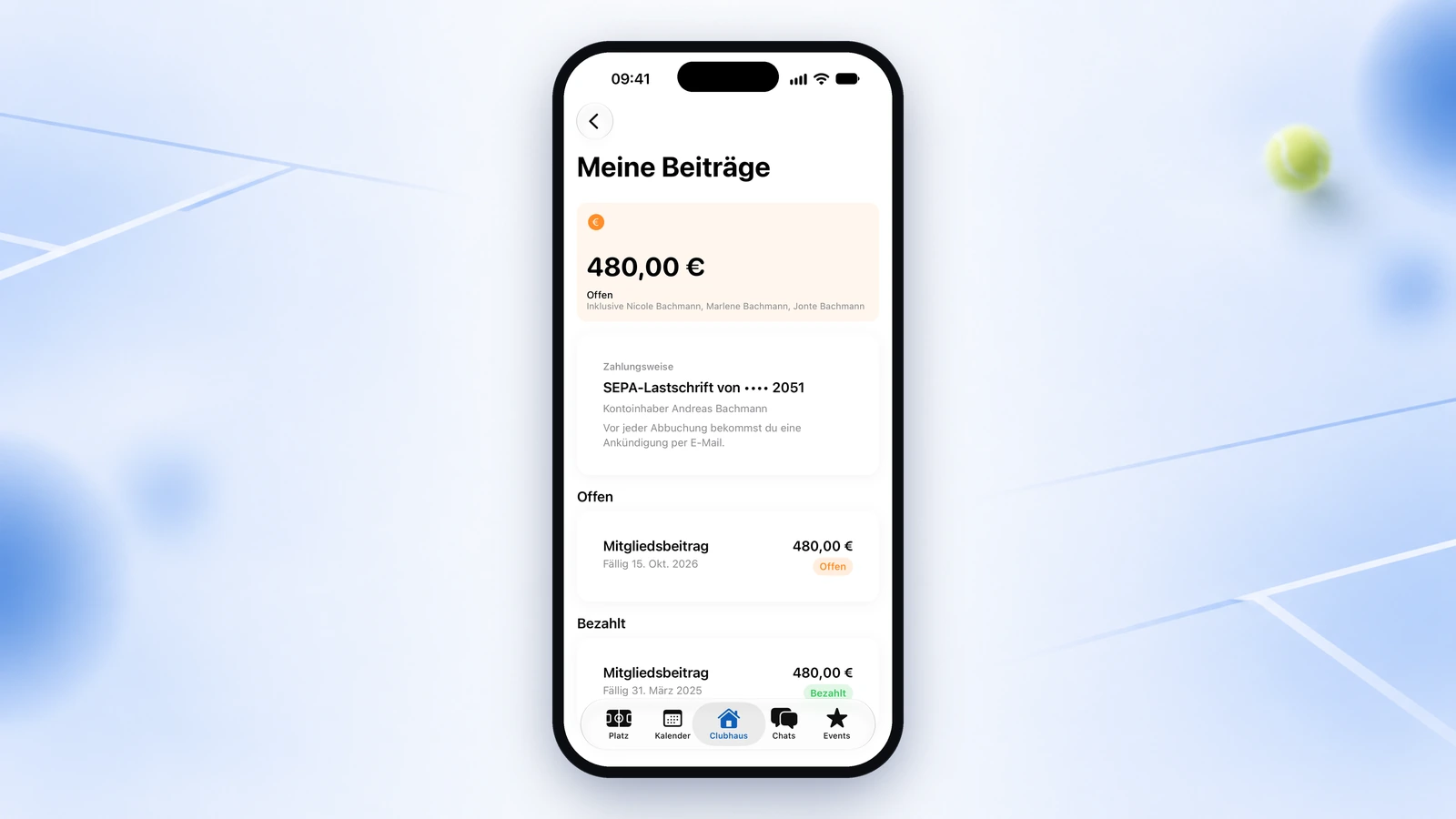
The most common question every treasurer gets: “What did you debit there?” In the app and the portal it now answers itself. Every member sees their own open and paid fees, the payment method and — if collected by direct debit — the last four digits of their account number. Anyone who pays for their children sees their fees too.
Emails that come from you — not from us
A dunning letter is sent by the club, not by Racqt. Until now you couldn’t tell from the emails: they carried our logo, our colours and our address in the footer. That’s changed. Emails to your members carry your logo, your club colour and your name as sender, and anyone who replies writes to you — not to our support.
The footer contains what belongs there: your club as the responsible party, with address, representatives, register number and contact, plus the legal notice and privacy policy of your club page. We suggest who represents the club from your registered committee — you can change it in the settings, because you’re responsible, not us. If a detail is missing, we say so in the same place instead of letting an incomplete email go out.
What stays the same technically: emails are still sent via our address. The big providers don’t let emails through in the name of someone else’s domain — they end up in spam. You’re the one people see, and the footer honestly says that Racqt delivered it.
Apart from that, all emails now look consistent and work reliably in every inbox: in Outlook, on a phone, in dark mode and even when the program blocks images. Every button also has the link as text underneath, and every email says why it was sent.
Before the first big send-out, test mode helps: you switch it on, and all your club’s emails go to your own addresses instead of to members — with attachments and everything, so you see what arrives. While it’s on, a notice appears above every admin page. You can’t leave it on by accident.
Usability and accessibility
Every window closes with the Escape key, focus stays inside while it’s open and then jumps back to where you were. All input fields are labelled for screen readers. Colours mean the same everywhere: green done, yellow waiting, red needs attention. And the large lists in the dashboard can be searched, sorted and boiled down to the columns you care about — Racqt remembers your choice.
Under the bonnet
The part you can’t see — and which still decides whether you trust a program.
Nobody has to wait any more. A reminder run sends emails, and that takes time. Until now the page waited for it and at some point reported an error — even though the reminders were long on their way. Anyone who took that as a failure would, if in doubt, send reminders a second time. Now the run starts, you keep working, and as soon as it’s done Racqt lets you know. A click on the message shows you who was reminded and what has been delivered — traceable, even weeks later.
Invoices are created reliably again. Our server was missing a component Racqt needs to generate PDF files. The result: the fee run reported “completed” but created no invoice — and since without an invoice there’s no invoice email either, everything stayed silent. The component is installed, and so that something like this doesn’t happen unnoticed again, Racqt now checks itself on start-up and writes the reason onto the run instead of just showing an error count. What matters most to us here: an error that doesn’t report itself is worse than one that does.
Large runs no longer slow anything down. A club with 600 members creates 600 invoices. This work now runs in a way that lets everyone else keep working normally in the meantime — and downloads that Racqt first has to calculate get the time they need instead of breaking off halfway.
Security nobody should notice. Like the Android app, the iPhone app now checks with every connection that it’s really talking to a Racqt server. Only signed-in users can now see a tennis school’s member list. And if a message via the contact form doesn’t reach us for once, we tell you straight away — instead of sending a confirmation that’s worth nothing.
What now?
1.6 has been live since 29 September. The apps for iPhone and Android follow after review by Apple and Google; your device will let you know by itself as soon as the update is ready for you. You’ll find the compact overview of the launch in Racqt 1.6 is here.
If you want to switch your fee collection over for the new year, now is the right time to go through your member data — categories, families, mandates. Write to us if you have questions or something is missing. Almost everything in this release started as a wish in an email or a conversation at the court.