 Racqt
Racqt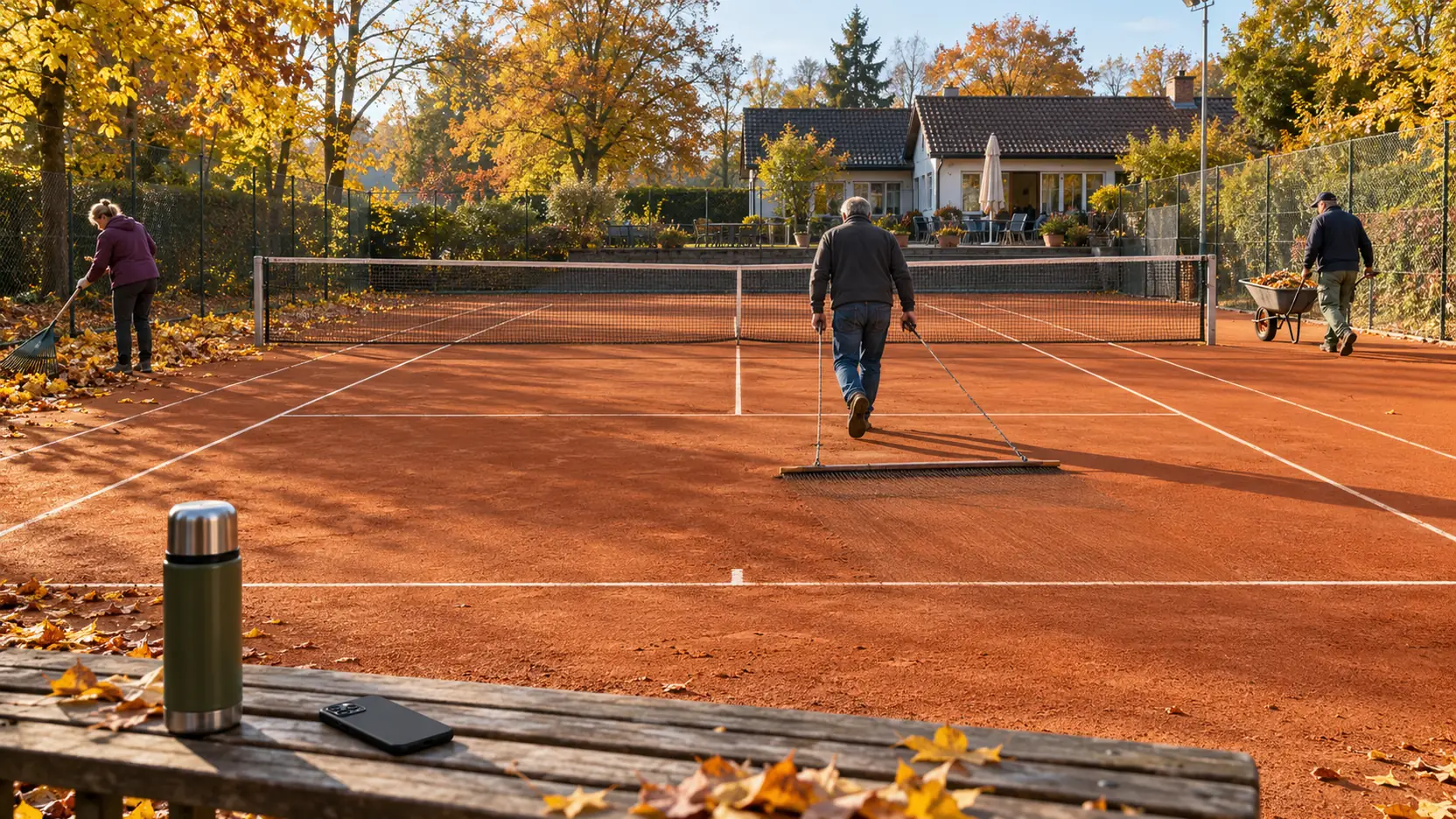
In many clubs, volunteer hours (“Arbeitsstunden”) are the obligation people argue about most — and the one that creates the most work. Not for the members who drag the court or trim the hedge, but for the person on the committee who afterwards types up lists, adds hours, calculates compensation payments and in spring explains why someone didn’t know about their extra hours.
Racqt has handled work sessions since version 1.4. With 1.7, which we’re planning for October, we’re tackling the rest: from check-in on the court to the bank transfer. The aim is the same as for fees in 1.6 — you shouldn’t need a spreadsheet next to it any more. The interface is in German; we name the German labels where it helps.
Check in, and the hours count
Until now, check-in in the app was a record of attendance. The hours were only credited once someone on the committee confirmed them — session by session, member by member.
From 1.7: if you check in at the work site, the scheduled hours are credited to you automatically when the session ends. Location confirms that someone was there; nothing more is needed. You can check in on the day of the session from one hour before it starts.
And if location doesn’t play along — a phone without GPS, no signal in the equipment shed, a session at the clubhouse rather than the court? Then the check-in is no longer rejected but becomes a request. Requests are collected under Verwaltung › Arbeitsstunden (Administration › Volunteer hours) in the new Freigaben (Approvals) tab: confirm individually, confirm with adjusted hours, confirm several at once or decline with a reason. The member sees in the app whether the request is still waiting or why it wasn’t accepted.
If someone left early or helped for longer, you correct it on the session’s page in the participant list — until the period is settled.
Your cut-off date, your period
Not every club works in calendar years. If you close the season in autumn, you want to settle volunteer hours in autumn too. From 1.7 the cut-off date determines the period: if your cut-off date is 30 September, everything from 1 October to 30 September of the following year counts. If you stay with 31 December, you won’t notice a difference.
If you introduce the volunteer hours obligation mid-year, you set from when it applies. Racqt doesn’t settle periods that end before then — nobody pays compensation for a time when the obligation didn’t even exist.
After the cut-off date, the finished period stays visible until it’s settled — for you in the evaluation and for your members in the app and the portal. That way someone can still make their choice for extra hours while the new period is already running.
Extra hours: you decide what they’re worth
Until now there was one hourly rate for everything. From 1.7, Racqt separates two things that have little to do with each other:
- The compensation rate applies to every missing hour.
- Paying for extra hours is a separate switch, with its own rate per extra hour. If it’s off, extra hours are counted but not paid.
If you pay for extra hours, you decide which options your members may choose: payout, donation to the club or both. If you like, payout is the default for everyone who doesn’t choose themselves. A donation, on the other hand, can never be the default — with us, nobody gives up money by staying silent. The former “let expire” option is therefore now part of the donation.
Your members can always see in the app and the portal where they stand: how many extra hours they have, roughly what they’re worth and what happens to them — whether by their own choice or by your default.
The legal notes are right next to the settings: that compensation needs a basis in the statutes or fee schedule, that payment should be fixed before the activity begins, and what the volunteer allowance (Ehrenamtspauschale) is about. They don’t replace tax advice — please have your arrangement checked by your tax adviser.
Preview first, then the run
Settlement at the end of the period now starts with a preview. It shows for each member what the run will do: compensation claim, payout, donation or nothing. And it warns you before something goes wrong:
- extra hours with no choice and no default that would otherwise not be paid,
- missing SEPA mandates,
- payouts above the volunteer allowance,
- missing club bank details and requests from the period that are still unconfirmed.
The run does nothing the preview didn’t show. If something has changed since the preview — for example because a member made their choice in the meantime — Racqt asks you to take another look. Then you download the bank files as usual: direct debits for compensation, transfers for payouts.
If someone is missing the SEPA mandate for a payout, the money isn’t lost: the payout stays pending, and as soon as the mandate is there you create a back-payment file — without touching the whole settlement again.
Racqt lets you know
The best settlement is no help if members only find out afterwards that they could have chosen. From 1.7, Racqt gets in touch by itself — as a notification in the app, as a push and by email:
- For the committee: when a new check-in request is waiting and when a payout is pending for lack of a mandate.
- For members: when they first go above their target in a period, 14 days before the cut-off date as a reminder — about their choice for extra hours or about the compensation that will otherwise be due — and when the mandate for a payout is still missing.
Every notification comes exactly once. And anyone who taps the push in the iPhone app lands straight in the volunteer hours of the right club.
A club website to be proud of
With 1.7 your public club website gets a new face too. Under Einstellungen › Erscheinungsbild (Settings › Appearance) you choose one of four templates, each with its own character:
- Tradition – classic and dignified, like a good club magazine
- Sport – modern and athletic, with big numbers and clean edges
- Gemeinschaft (Community) – warm and friendly, with soft shapes
- Energie (Energy) – bright and fresh, with lots of space
One club colour is enough. The template brings fonts, surfaces and spacing, and Racqt makes sure text and buttons always stay easy to read – even with very light colours. If you don’t choose a colour, the template’s colour applies. To the right you see your home page in the chosen look before you save.
Everything is built from building blocks that look right in every template: you put your pages together, and the template takes care of the rest. Before the release, more building blocks will be added – including events, news, teams and sponsors that fill themselves directly from your Racqt data – and the subpages of your website will move to the new design too.
What’s still to come
Two things are still in progress:
Android. Work sessions, registration and check-in are so far only available on the iPhone and in the portal. The Android app will catch up — including the overview and the choice for extra hours.
Donation with a donation receipt. Many clubs want members to donate their extra hours and receive a donation receipt for it. For tax purposes this is a waiver-based donation with clear rules: the claim must first arise, then it is waived voluntarily and promptly. Racqt maps exactly this process — intention before the cut-off date, waiver after settlement, export for the receipts. We’ll only release this part once the texts have been checked for tax purposes.
What now?
If you already keep volunteer hours in Racqt, now is a good moment to review your arrangement: when is your cut-off date? Do you pay for extra hours, and if so, how? Should payout be the default — and do your members know that yet? If you’ve settled this beforehand, you enter it in the settings in a few minutes with 1.7 — and announce it to your members in good time before the cut-off date.
As always: much of this release started as a wish in an email or a conversation at the court. Write to us if things work differently at your club from how we imagine.